On June 6, 1941, the elegant Brookville residence of Gerald F. Warburg was photographed, preserving a remarkable glimpse of life on Long Island’s Gold Coast. The property on Cedar Swamp Road belonged to a member of one of New York’s most prominent banking families and featured formal living spaces, a private music studio and a terrace furnished for afternoon tea. It was the sort of country home that reflected the considerable fortunes being spent on the North Shore during the early twentieth century.
The photographs, preserved in the Library of Congress’s Gottscho-Schleisner Collection, document the residence’s architecture and interiors just six months before America’s entry into World War II. The collection credits the architectural firm LaFarge & Knox with the property, providing a visual record of a Gold Coast household during the final years of Long Island’s great estate era.
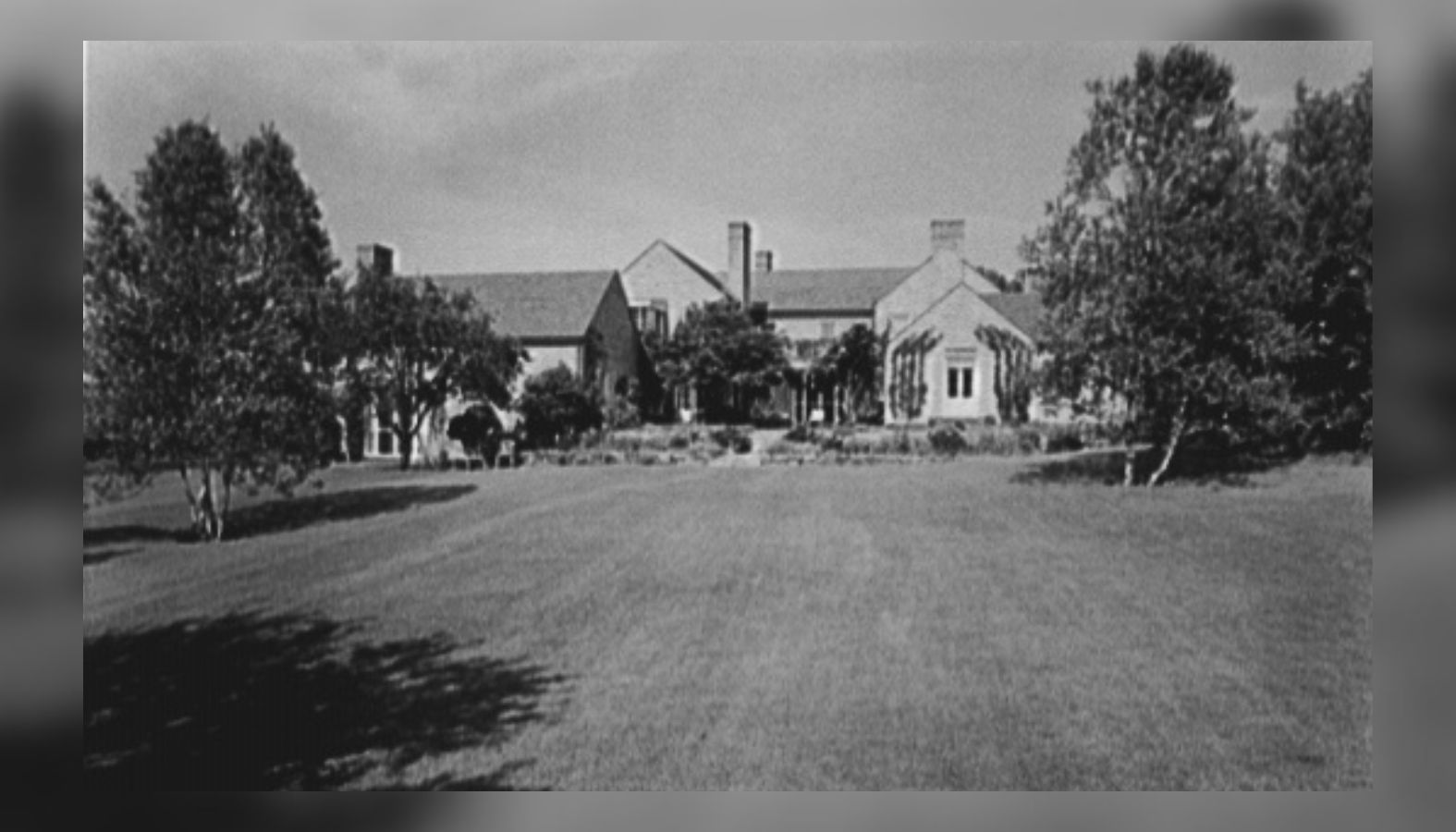
Photo: The garden facade of Gerald F. Warburg’s residence on Cedar Swamp Road in Brookville, photographed June 6, 1941. (Gottscho-Schleisner Collection, Library of Congress, Prints and Photographs Division)
A family with considerable means
Gerald Warburg was the son of Felix M. Warburg, a partner in the powerful New York investment banking firm Kuhn, Loeb & Co., and Frieda Schiff Warburg, whose father, Jacob H. Schiff, was a senior partner in the same firm. The Warburg and Schiff families occupied an influential position in American finance, philanthropy and cultural life during the late nineteenth and early twentieth centuries.
The family’s wealth was reflected in its residences. Felix and Frieda maintained an elaborate mansion at 1109 Fifth Avenue in Manhattan, completed in 1908, along with a country estate known as Woodlands in White Plains. The Fifth Avenue mansion, designed by architect C. P. H. Gilbert, would eventually become the home of the Jewish Museum.
Gerald’s Brookville residence was another part of the family’s extensive residential world. The connection helps place the Long Island property in perspective: these were families accustomed to substantial homes, carefully maintained grounds and the considerable expense of operating private estates.
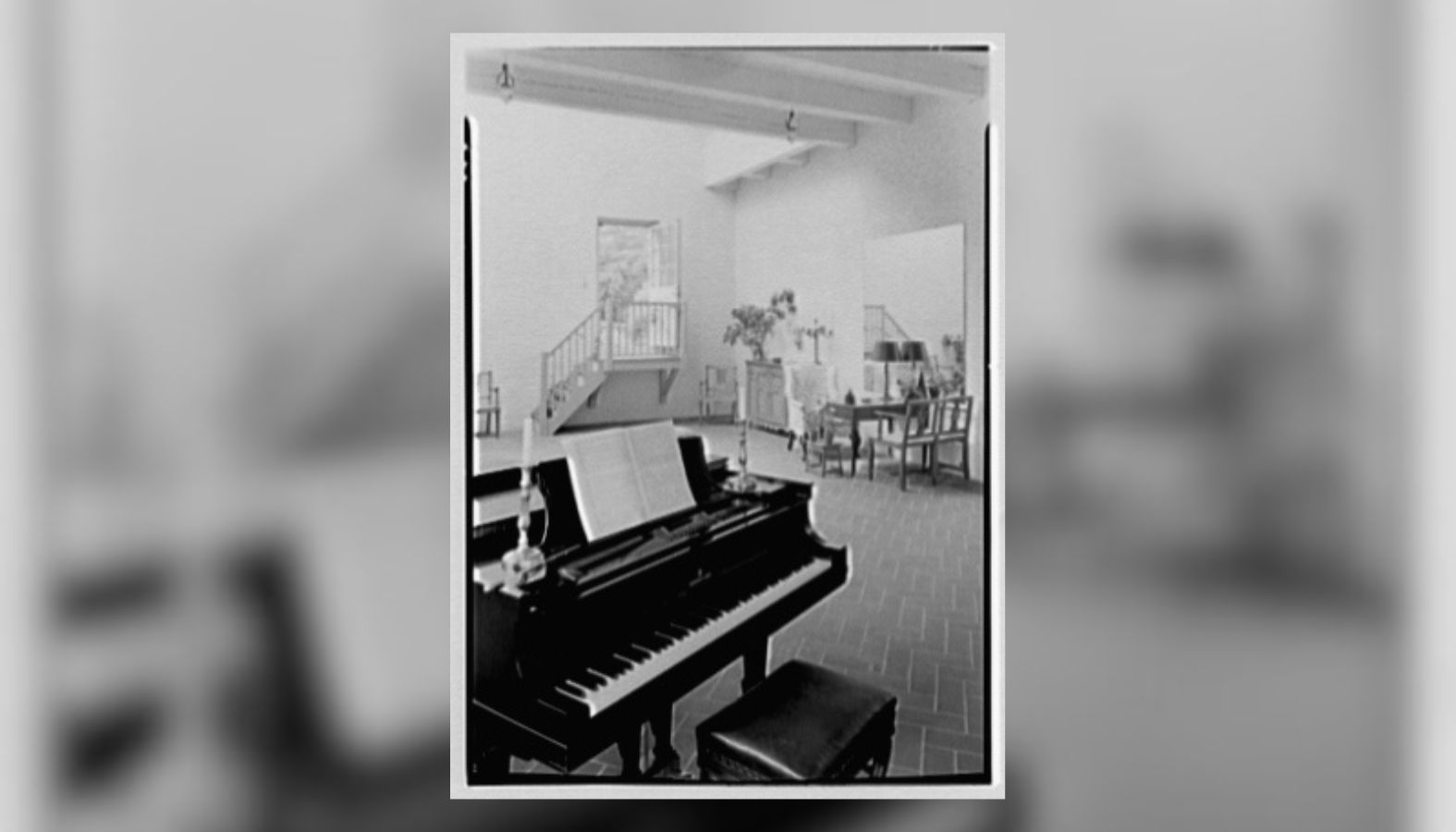
Photo: The music studio at Gerald F. Warburg’s Brookville estate, with a piano keyboard in the foreground, photographed June 18, 1941. (Gottscho-Schleisner Collection, Library of Congress, Prints and Photographs Division)
When Brookville became part of the Gold Coast
The Warburg residence stood in a community that had been transformed by the arrival of wealthy New Yorkers. During the early twentieth century, Brookville’s farms and woodlands increasingly gave way to large private properties as financiers, industrialists and other affluent families purchased land for country homes.
The transformation was extensive. According to the Village of Brookville’s official history, approximately 22 large estates occupied the area that would eventually become the incorporated village by 1923. The homes were surrounded by landscaped grounds, while their maintenance created employment for gardeners, domestic workers and other staff from nearby communities, including Westbury, Oyster Bay and Hicksville.
Click here for more stories about Long Island’s historic landmarks.
Brookville’s wealthy property owners also sought to protect the area’s exclusive residential character. In 1931, estate owners helped organize the village’s incorporation, initially encompassing a narrow stretch of land centered along Cedar Swamp Road. Their objective was to limit the sort of residential and commercial development spreading through other parts of Nassau County.
The scale of Brookville’s Gold Coast development can be appreciated through some of its other estates. Broadhollow, the property of banker and diplomat Winthrop W. Aldrich, encompassed 108 acres and included a 40-room manor house. Marjorie Merriweather Post and financier E. F. Hutton maintained Hillwood, a sprawling Tudor Revival mansion on approximately 178 acres that later became part of Long Island University’s C.W. Post campus.
These properties were separate from the Warburg residence, but they illustrate the extraordinary scale of country living in the surrounding community. In Brookville, a substantial mansion was hardly an unusual ambition among families with sufficient money to build and maintain one.
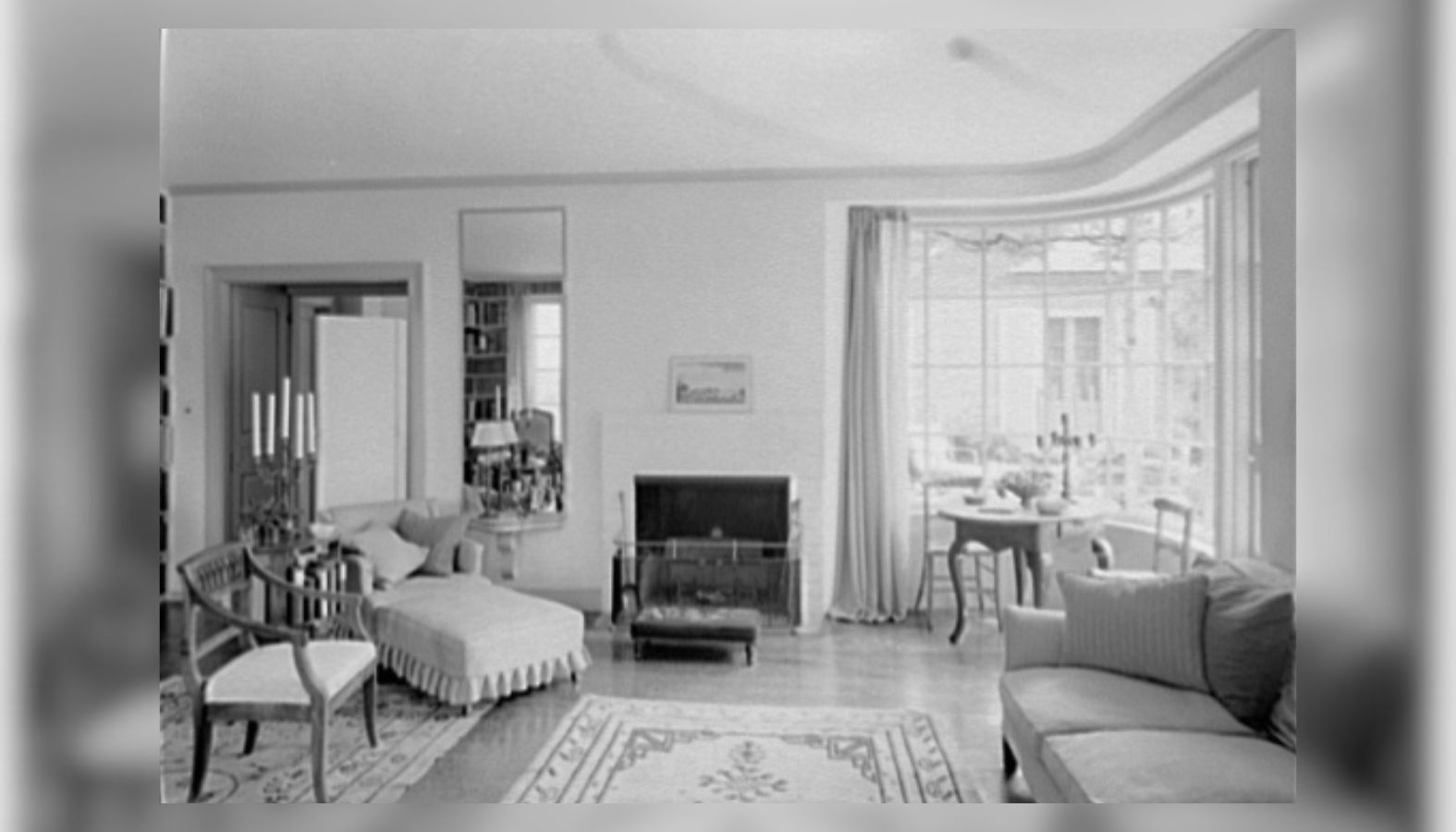
Photo: The living room of Gerald F. Warburg’s Brookville residence, showing the fireplace and window, photographed June 18, 1941. (Gottscho-Schleisner Collection, Library of Congress, Prints and Photographs Division)
A look inside the Warburg residence
The surviving photographs of Gerald Warburg’s Brookville home provide an unusually detailed record of its interiors. Views identified as the entrance hall, living room, dining room, bedroom and studio reveal a residence arranged for both private living and formal entertaining.
The living room photographs document a fireplace, windows and carefully furnished interiors, while views of the entrance hall show the home’s staircase. Exterior photographs record its entrance and garden facades, connecting the formal interior spaces to the surrounding property.
For the Gold Coast’s wealthy residents, the distinction between ordinary domestic comfort and architectural extravagance could be considerable. Spacious rooms, carefully selected furnishings and separate areas devoted to particular activities were among the advantages of having the financial resources to build a country residence on this scale.
The photographs also reveal something distinctive about Warburg himself. Among the rooms documented at the Brookville house was a studio containing a piano, seating and windows, a feature particularly appropriate for its owner.
A musician in a banking dynasty
Unlike his father and grandfather, whose careers were devoted to finance, Gerald Warburg pursued professional music. He became an accomplished cellist and conductor, studying music in the United States and Europe and performing with the Stradivarius Quartet.
His musical career was well established before the Brookville photographs were taken. In November 1927, the Jewish Telegraphic Agency reported on a cello performance Warburg gave in Vienna, where his playing received favorable reviews.
In February 1930, The Harvard Crimson identified Warburg as the cellist of the Stradivarius Quartet during the ensemble’s final public concert of the season at Harvard’s Fogg Art Museum. The newspaper reported that the quartet’s musicians had four Stradivarius instruments at their disposal, placing Warburg among performers entrusted with some of the most celebrated instruments in classical music.
The studio in his Brookville residence was therefore more than an ornamental addition to a wealthy family’s country home. It was a fitting space for someone who had established a professional life in music, supported by the resources of one of New York’s leading banking families.
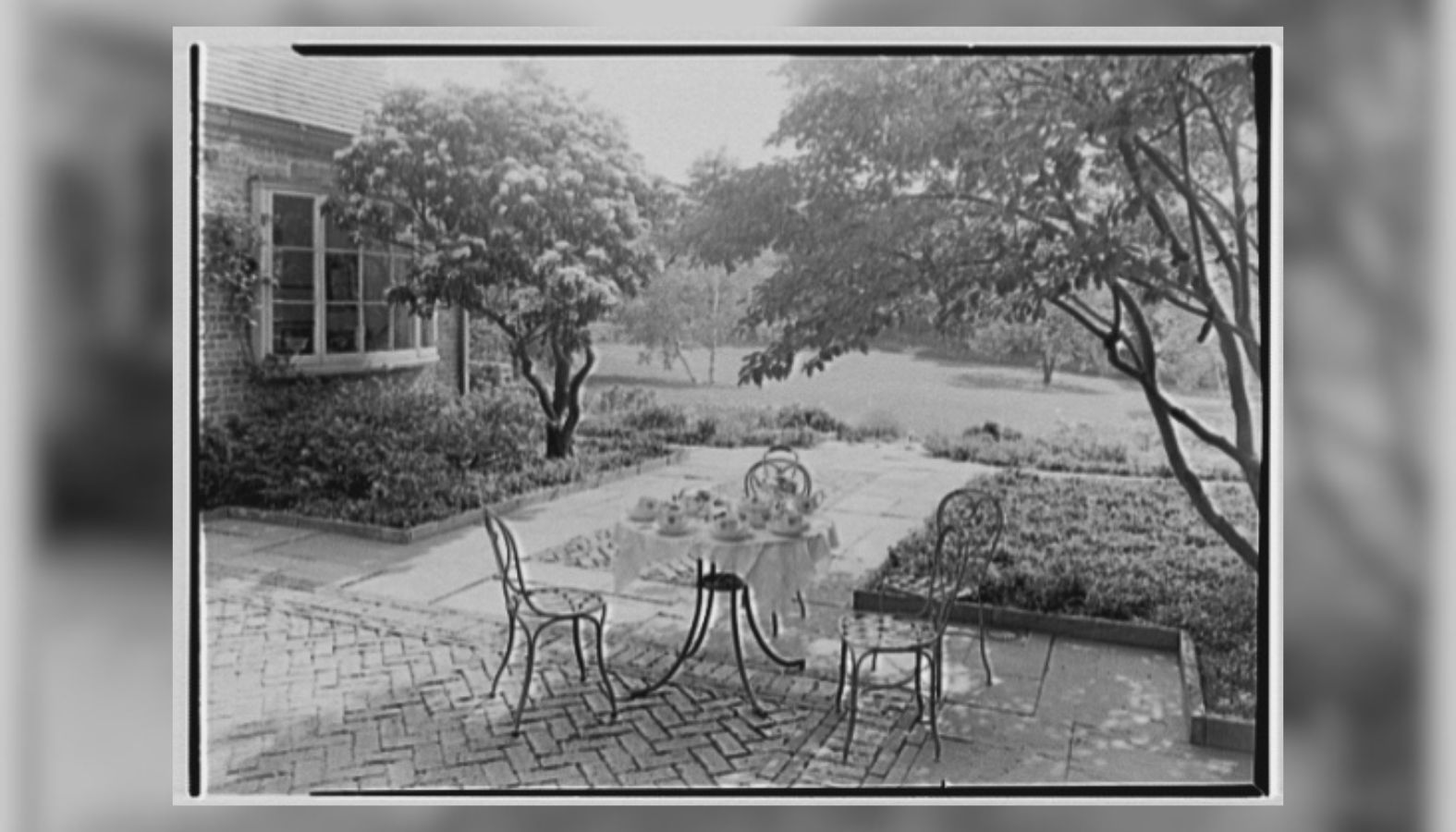
Photo: A tea table arranged on the terrace of Gerald F. Warburg’s Gold Coast residence in Brookville on June 6, 1941. (Gottscho-Schleisner Collection, Library of Congress, Prints and Photographs Division)
Afternoon tea, Gold Coast style
One of the most charming photographs in the Library of Congress collection shows a tea table arranged on the terrace of the Warburg residence. Taken on June 6, 1941, the image captures a carefully furnished outdoor setting that conveys the comforts of Gold Coast country living.
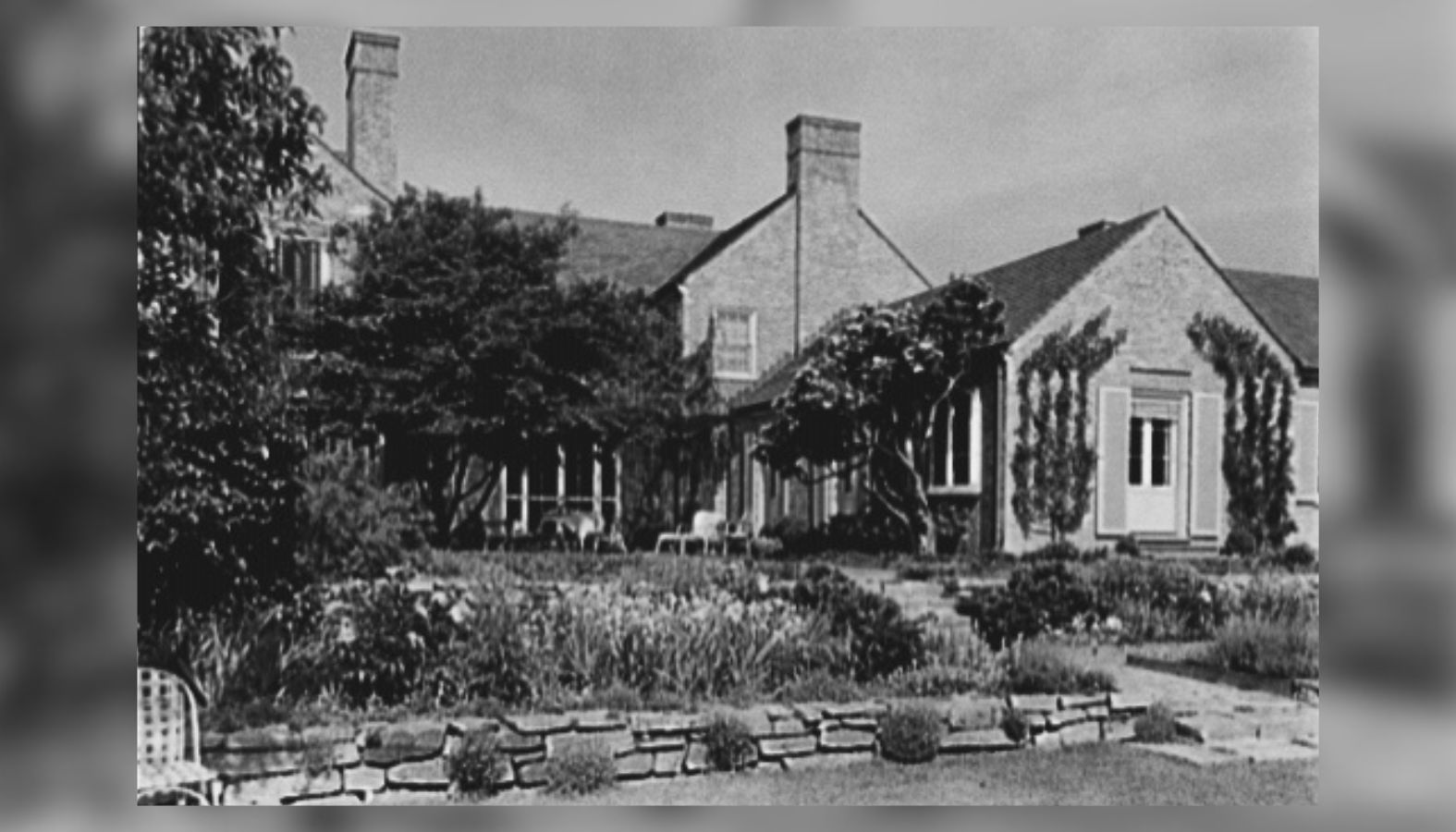
The terrace extended the living space beyond the house, providing an elegant setting for enjoying the surrounding grounds. For families accustomed to substantial private estates, even the relatively simple pleasure of afternoon tea could be accommodated with its own thoughtfully arranged space.
There is something wonderfully characteristic of the Gold Coast in that detail. While most people could manage a cup of tea at the kitchen table, the Warburg residence offered a dedicated terrace where the architecture, furnishings and outdoor surroundings all contributed to the occasion.
The setting also reflects the broader culture of North Shore estate living during the period. Large country houses were designed not only to provide private accommodations but also to create comfortable environments for entertaining, recreation and the enjoyment of carefully maintained grounds.
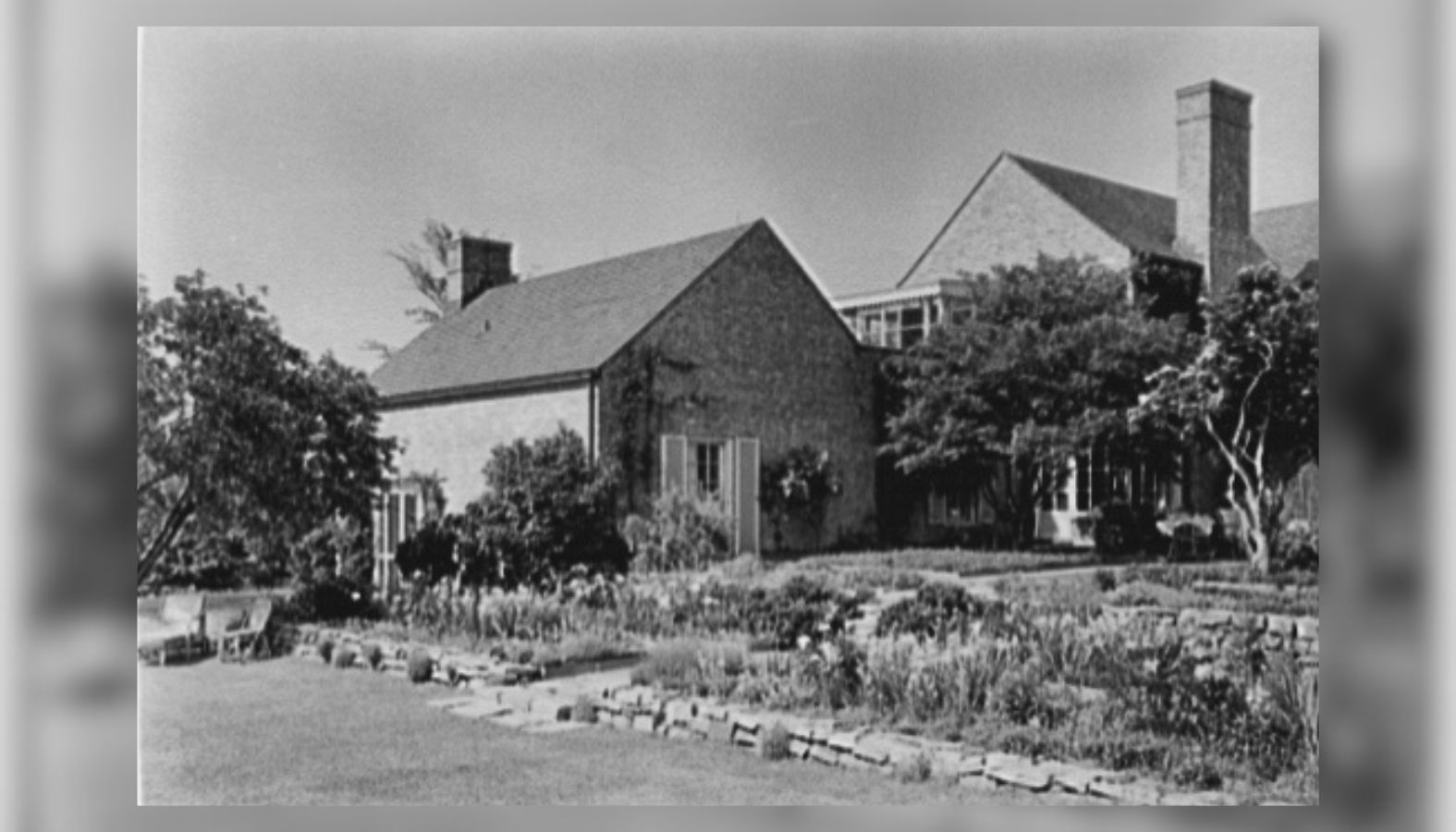
Photo: The terrace of Gerald F. Warburg’s Gold Coast residence in Brookville, photographed from the right on June 6, 1941. (Gottscho-Schleisner Collection, Library of Congress, Prints and Photographs Division)
A Gold Coast residence on the eve of war
The photographs were taken during the final months before the United States entered World War II. When Gottscho-Schleisner documented the Warburg residence in June 1941, war was already underway in Europe, but the United States would not enter the conflict until after the Japanese attack on Pearl Harbor that December.
The war marked a turning point in the history of Long Island’s great estates. In the following decades, many large North Shore properties were subdivided as land values, development patterns and the economics of maintaining extensive private estates changed.
Brookville experienced that transformation as well. Although the village retained much of its residential character, many properties established during the Gold Coast era were eventually divided into smaller parcels.
The 1941 photographs preserve the Warburg residence as it appeared during that earlier period of country-house living. Its formal rooms, music studio and terrace reflect the comforts available to a family whose financial resources and cultural interests shaped the home they maintained on Long Island.
For a community once filled with extravagant private estates, the photographs are a valuable record of how that wealth translated into the spaces of everyday life. The Warburg home offers a particularly interesting example, combining the financial legacy of one of New York’s great banking families with the personal interests of a professional musician in the heart of Brookville’s Gold Coast.
Sources:
- Library of Congress, Gottscho-Schleisner Collection – Gerald F. Warburg residence, Brookville, June 6, 1941. Primary photographic documentation of the residence, including its terrace, and attribution to LaFarge & Knox. https://www.loc.gov/item/2018739752/
- Village of Brookville, Official History – History of Brookville’s Gold Coast estates, wealthy landowners, village incorporation in 1931, and the subdivision of large estates after World War II. https://www.villageofbrookville.gov/history
- American Jewish Archives, Felix M. Warburg Papers – Biographical and family background on Felix M. Warburg, Frieda Schiff Warburg, and their children, including Gerald Warburg. https://7079.sydneyplus.com/archive/final/ViewRecord.aspx?record=8d605b9a-3c23-4ef4-856b-dfc4ab032abb&template=Collection
- American Jewish Archives, Concise Dictionary of American Jewish Biography – Biographical information about Gerald Warburg, including his career as a cellist and associations with the New York Philharmonic, Stradivarius Quartet, and Brooklyn Symphony Orchestra. https://www.americanjewisharchives.org/wp-content/uploads/concise-dictionary-of-american-jewish-biography-complete.pdf
- Jewish Telegraphic Agency, November 7, 1927 – Contemporary reporting on Gerald Warburg’s cello performance in Vienna. https://www.jta.org/archive/gerald-warburg-hailed-in-vienna-at-cello-concert
- New York City Landmarks Preservation Commission, Felix Warburg Mansion Designation Report – Historical documentation of the Warburg family’s Manhattan mansion and other family properties. Used for family background, not as evidence of features at the Brookville residence. https://s-media.nyc.gov/agencies/lpc/lp/1116.pdf
- Long Island University, Our Heritage: The Post/Hutton Dynasty – Historical background on Marjorie Merriweather Post and E. F. Hutton’s Hillwood estate in Brookville, including its Tudor Revival mansion, acreage, and connection to the university’s C.W. Post campus. https://www.liu.edu/post/Academics/school-of-professional-studies/~/media/EB4B3723F6C54EBAB7CA10F3504A375C.ashx
- Smithsonian Institution, Archives of American Gardens – Historical documentation of the Hillwood estate, its ownership by Marjorie Merriweather Post and E. F. Hutton, and the property’s acquisition by Long Island University in 1947. https://gardens.si.edu/collections/explore/ead_component/sova-aag-gca-ref27001
Header photo: The terrace of Gerald F. Warburg’s Gold Coast residence in Brookville, photographed from the left on June 6, 1941. (Gottscho-Schleisner Collection, Library of Congress, Prints and Photographs Division)