At its peak in the late 1940s, Long Island had more than 70,000 acres devoted to growing potatoes, making it one of the country’s important potato-producing regions. Fields stretched across much of Suffolk County and into Nassau, supplying potatoes to New York City and markets beyond. The crop was so closely associated with Long Island that growers organized elaborate potato festivals, crowned potato queens and promoted their harvests with enormous displays of potatoes.
Today, much of that farmland has disappeared beneath suburban neighborhoods, commercial developments and roads. According to the 2022 U.S. Census of Agriculture, Suffolk County harvested potatoes on just 1,316 acres, a small fraction of the acreage that once defined Long Island agriculture.
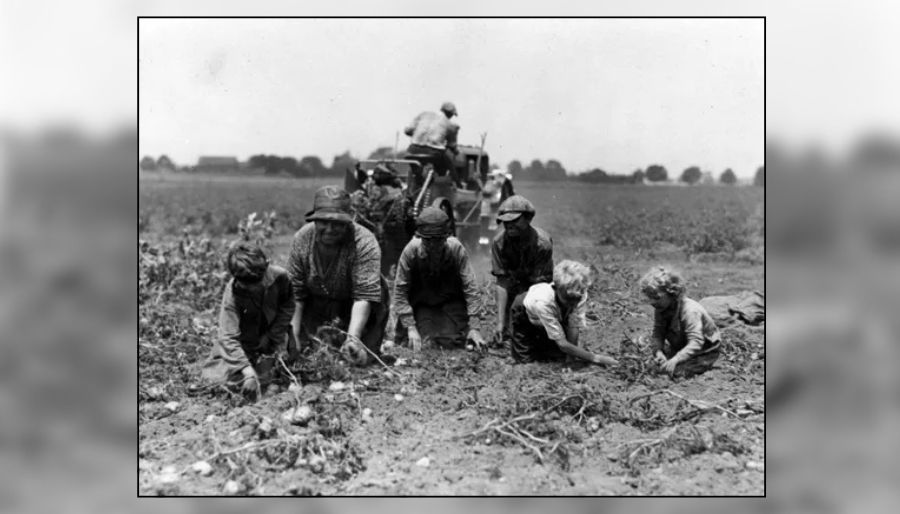
Photo: The five youngest children of John Wesnofske pick potatoes by hand in 1919, while a tractor-drawn mechanical digger operates behind them. Although mechanized digging had arrived, gathering and bagging potatoes remained labor-intensive work. (Wesnofske family collection.)
How Long Island became potato country
Potatoes have been grown on Long Island for centuries, although the earliest accounts are difficult to verify. Suffolk County historian Morton Pennypacker recorded a tradition that Lion Gardiner planted white potatoes on Gardiner’s Island in 1637. The account is part of the island’s agricultural lore, but the documented history of commercial potato cultivation is much more firmly established in the nineteenth century.
Long Island’s sandy, well-drained soils and relatively moderate coastal climate proved well suited to potato cultivation. Proximity to New York City provided another important advantage, giving farmers access to an enormous market without the long-distance transportation required of growers in other parts of the country.
By the early twentieth century, potato farming had become a major part of the local economy. Farming families, including immigrants of German, Polish and Irish ancestry, established operations across the island, particularly in Suffolk County.
Some of these families had previously farmed in Queens or Nassau before suburban development pushed agriculture farther east. Their experiences reflected a pattern that would eventually transform nearly every agricultural community on Long Island.
When potatoes dominated the fields
Long Island’s potato industry expanded dramatically during the first half of the twentieth century. Cornell University agricultural research documented an average of 59,200 acres harvested annually between 1940 and 1944, increasing to 63,800 acres annually between 1945 and 1949.
Production was substantial as well. During the 1945–1949 period, Long Island farmers harvested an annual average of approximately 11.3 million hundredweight of potatoes, equivalent to more than 1.1 billion pounds.
The Suffolk County Historical Society reports that potato acreage exceeded 70,000 acres during the late 1940s. By the 1950s, Suffolk County ranked third among American counties in potato production, an indication of just how important Long Island had become to the national industry.
Popular varieties included Green Mountain and Irish Cobbler, along with other varieties suited to local growing conditions and market demand. The crop required considerable labor, particularly during planting and harvesting, when workers collected, sorted and packed potatoes for shipment.
The industry continued to be economically significant well into the 1960s. A Cornell agricultural report published in 1968 found that Long Island produced 53 percent of New York State’s potatoes in 1964, while approximately one-third of the island’s commercial farms specialized in the crop.
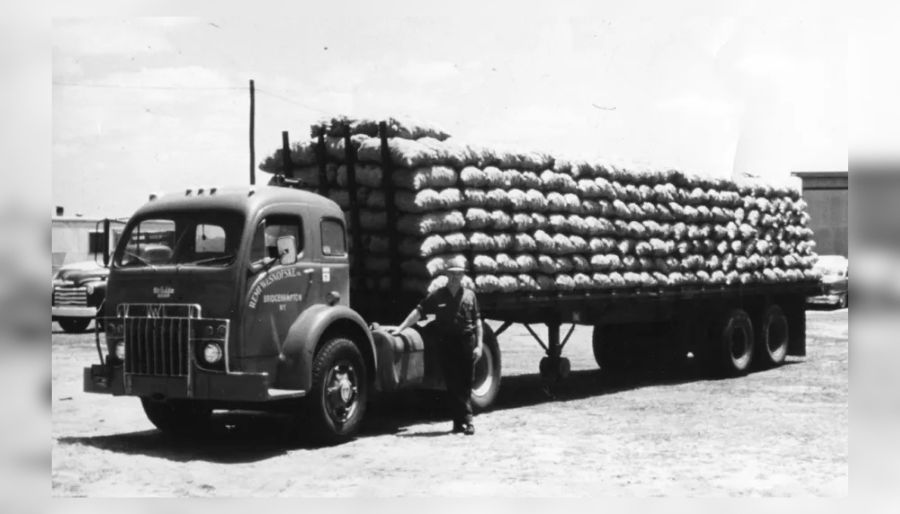
Photo: Remi Wesnofske stands beside his White cab-over-engine tractor and flatbed trailer loaded with 100-pound sacks of potatoes in Bridgehampton, circa 1965. (Wesnofske family collection.)
Potato festivals, queens and a mountain of spuds
Long Island growers understood the importance of promoting their potatoes, particularly as they competed with producers in other states. Their efforts included an event that would be difficult to mistake for anything other than a celebration of agriculture.
In 1937, the first Long Island Potato Festival was held in Riverhead on the grounds of the Suffolk County Agricultural Society. Organizers advertised the event as a promotional campaign for locally grown potatoes, hoping to strengthen the Long Island brand in markets where growers from other states were competing for customers.
One of the festival’s most unusual attractions was a mountain constructed from more than 1,000 bushels of potatoes. Visitors were invited to take home sample bags from the enormous pile, giving them a tangible reminder of the region’s agricultural output.
Potato festivals also featured the crowning of a Long Island Potato Queen, a beauty-pageant tradition associated with local farming families. The title reflected the importance of the industry in communities where potato growing was a major source of employment and income.
The celebrations continued in various forms long after the industry’s peak. In 1982, a potato festival in Yaphank was advertised with potato-themed folk music and competitive activities described as Spud Sports.
The crop even attracted national professional attention. In July 1963, the Potato Association of America held its 50th anniversary meeting at the Henry Perkins Hotel in Riverhead, recognition of Long Island’s longstanding importance to potato cultivation and agricultural research.
The disappearance of Long Island’s potato fields
The decline of potato farming was closely connected to the transformation of Long Island after World War II. As suburban development expanded eastward, farmland became increasingly valuable for residential and commercial construction.
The changes were especially dramatic in Nassau County, where agricultural land was rapidly converted into suburban neighborhoods. Families that had farmed for generations faced rising property values, development pressure and the increasing difficulty of maintaining large agricultural operations.
But development was only part of the problem. Long Island farmers also faced rising labor and production costs, fluctuating crop prices and competition from large potato-growing regions in states such as Idaho, Washington and Maine.
The economics of potato farming became increasingly difficult as the century progressed. Some families sold their land, while others shifted into different agricultural products, including nursery stock, vegetables and, eventually, wine grapes.
The broader decline of farming was substantial. Suffolk County had approximately 123,000 acres of farmland in 1950, but the 2022 Census of Agriculture recorded only 33,821 acres remaining.
Potatoes experienced an even sharper contraction. According to the New York State Comptroller, Suffolk County harvested 2,605 acres of potatoes in 2012, but only 1,316 acres in 2022, when 46 farms reported growing the crop.
Despite that decline, Suffolk still ranked third among New York counties in harvested potato acreage in 2022. Long Island had lost most of its potato fields, but the crop remained a significant part of its surviving agricultural economy.
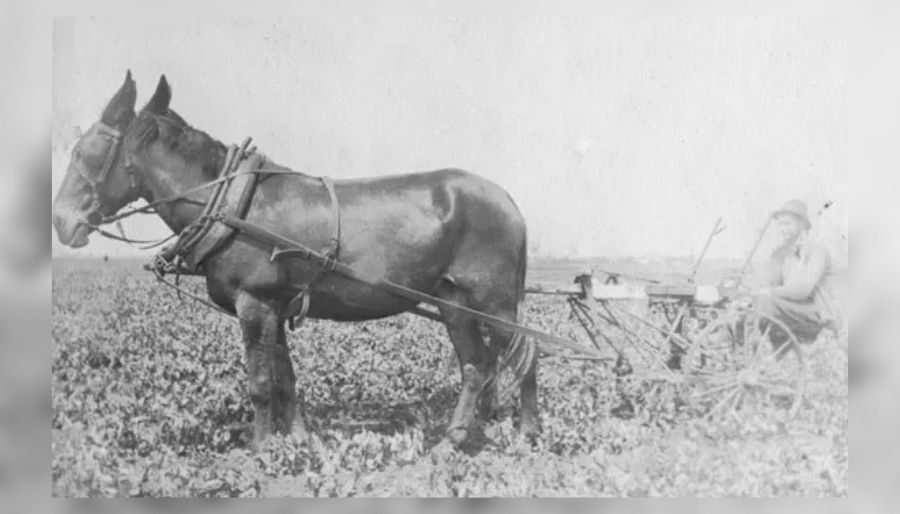
Photo: Joseph Wesnofske, the oldest son of potato farmer John Wesnofske, cultivates a Long Island field using two mules in 1917. The photograph documents farming methods before tractors largely replaced animal-drawn equipment. (Wesnofske family collection.)
From potato fields to potato chips and vodka
Some Long Island farming families have adapted by finding additional ways to market their crops. Instead of relying entirely on wholesale potato sales, growers and local businesses have developed products that emphasize the agricultural history of the region.
North Fork Potato Chips, based in Cutchogue, is one example of a business built around the Long Island potato. Its kettle-cooked chips connect a familiar snack food with the North Fork’s longstanding farming tradition.
Potatoes have also become an ingredient in Long Island’s craft-distilling industry. Long Island Spirits, established in Baiting Hollow in 2007, produces LiV Original Vodka using locally grown Long Island potatoes.
In Sagaponack, the Foster family’s agricultural operation provides another example of how potato farming has survived. The family has farmed the area for six generations, and Sagaponack Farm Distillery produces potato vodka using potatoes grown on the family’s land.
The Foster family’s Marilee’s Farmstand identifies its associated Sagaponack Potato Company as farming approximately 200 acres of potatoes and small grains, along with 30 acres of vegetables. The operation reflects how some longstanding agricultural families have diversified while continuing to cultivate the land.
A crop that helped shape Long Island
The potato industry’s influence extended beyond individual farms. It supported agricultural equipment dealers, packing operations, transportation businesses, seasonal employment and the communities where farming families lived and worked.
Historic photographs preserve a landscape that was once commonplace across Long Island: long rows of potato plants, harvesting crews, trucks loaded with produce and farm buildings surrounded by cultivated fields. Even places now associated almost entirely with suburban development were once part of this agricultural economy.
The Suffolk County Historical Society’s archives include a promotional postcard depicting an enormous Long Island potato being transported on a Long Island Rail Road train. The exaggerated image was intended to advertise the crop, but it also demonstrates how closely Long Island’s identity was connected to its potatoes.
Although the acreage has declined dramatically, the surviving potato farms of the North and South Forks maintain a direct connection to that history. Long Island’s agricultural landscape has changed almost beyond recognition since the 1940s, but the potato remains one of the crops that helped build its farming economy.
Sources & Further Reading
- Suffolk County Historical Society: The Long Island Potato — Historical potato acreage, production rankings and the industry’s development.
- Cornell University: Costs in Producing Potatoes, 1960 — Historical potato acreage and production statistics.
- New York State Comptroller: Profile of Agriculture in New York State — Suffolk County potato acreage and agricultural census data.
- Montauk Library: Celebrating the Long Island Potato — The 1937 Long Island Potato Festival in Riverhead.
- Cornell University: New York Agricultural Statistics, 1968 — Historical agricultural production and Long Island’s contribution to New York State’s potato industry.
- Marilee’s Farmstand: Official Website — History of the Foster family’s farming operations in Sagaponack.
- Sagaponack Farm Distillery: Official Website — Contemporary potato farming and locally produced spirits.
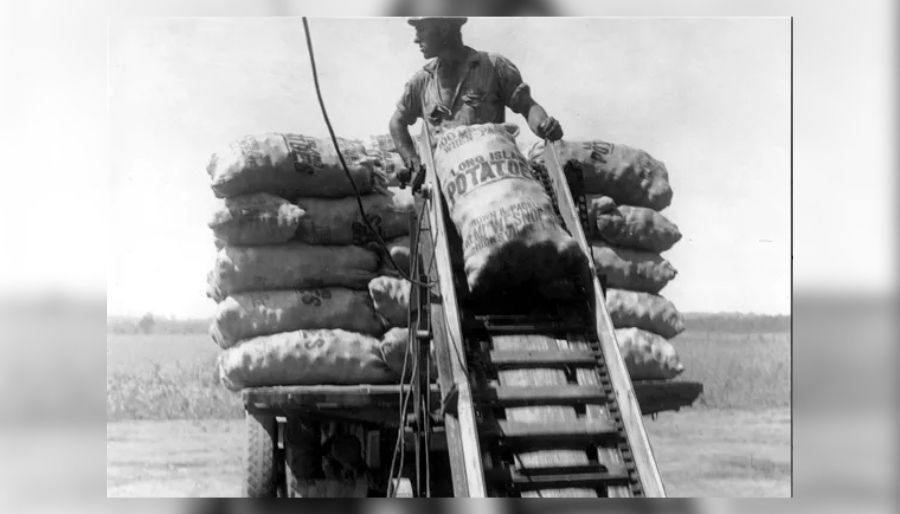
Cover photo: A worker uses a Boggs wooden mechanical loader to move sacks of potatoes onto a truck at the Wesnofske family farm in Melville, circa 1948. The equipment reduced the manual labor required to load heavy potato sacks. (Courtesy of the Wesnofske family.)