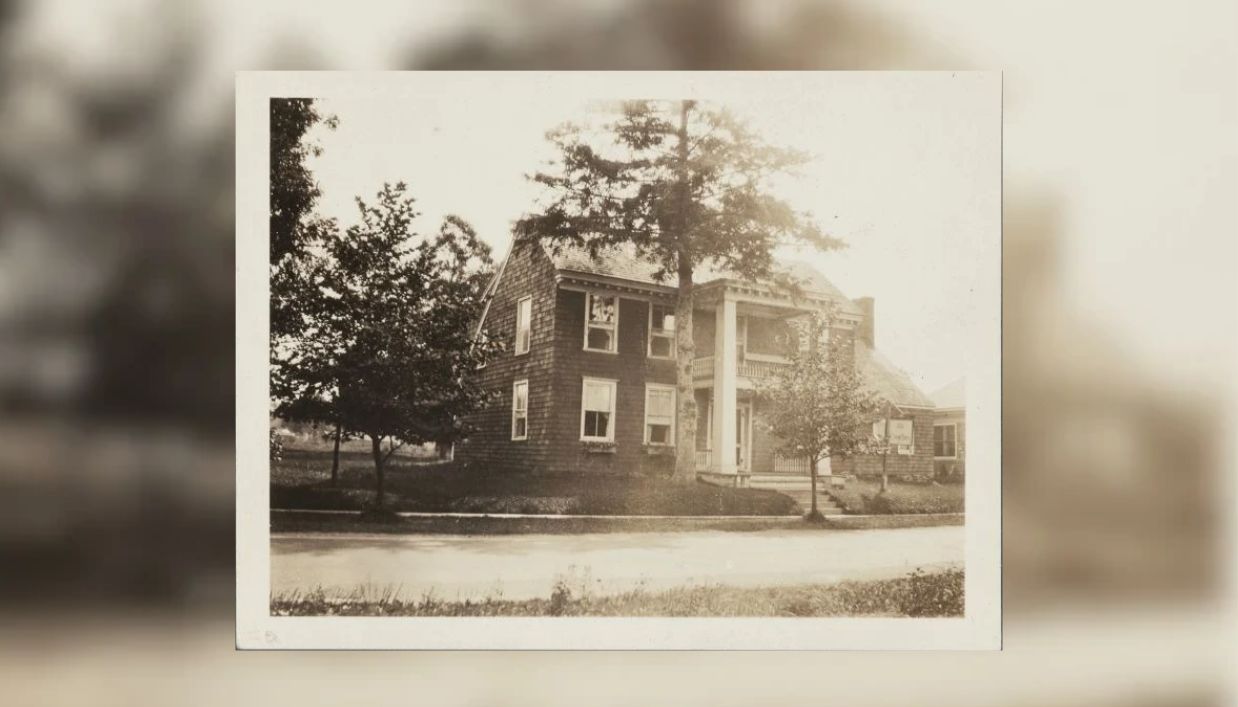
A New York Public Library photograph taken in September 1924 shows a business identified as the “Old Shingled Sides” Tea Room on the south side of Main Street, opposite Shore Road, in East Setauket. The name and location correspond to the historic East Setauket house generally known in local histories as Old Shinglesides, a building that had already stood for generations before it was used as a tea room.
The NYPL photograph is part of Eugene L. Armbruster’s extensive collection of Long Island views. Armbruster, who documented communities across Long Island during the early 20th century, recorded the East Setauket building specifically as a tea room in September 1924. The library catalog uses the form “Old Shingled Sides,” while Three Village historical sources generally use “Old Shinglesides.”
A house dating to 1754
Three Village historian Beverly C. Tyler dates Old Shinglesides to 1754. According to that account, Ebenezer Jones purchased the house in 1760, and it later became the home of Walter Jones Sr. and Charity Smith Jones. Within the Jones family it was also known as the Mansion House, a name associated with Walter Jones Sr.’s position as the senior member of the family.
Walter and Charity Jones married in January 1824, and Charity moved into the house as an 18-year-old bride. Walter remained there until his death in 1877. Charity continued living there afterward and was still in the house when writer Thomas J. Vivian visited Setauket for an article published in Frank Leslie’s Popular Monthly in August 1895.
Vivian considered the old house one of Setauket’s notable buildings. He described its weathered shingles, central chimneys, box shrubs and small-paned windows, calling it the “gem of the whole place.” Inside, he found an old-fashioned interior that included fireplaces, paneled rooms and deep window seats. Charity told him she had lived in the house since her marriage in 1824.
The early history can be summarized this way:
- 1754: Local historical accounts date the construction of Old Shinglesides to this year.
- 1760: Ebenezer Jones purchased the house.
- 1824: Walter Jones Sr. and Charity Smith Jones began their married life there.
By 1895, the house had already become something of a local landmark. Charity Jones died in 1897 at age 91 and was buried in the Setauket Presbyterian Church graveyard.
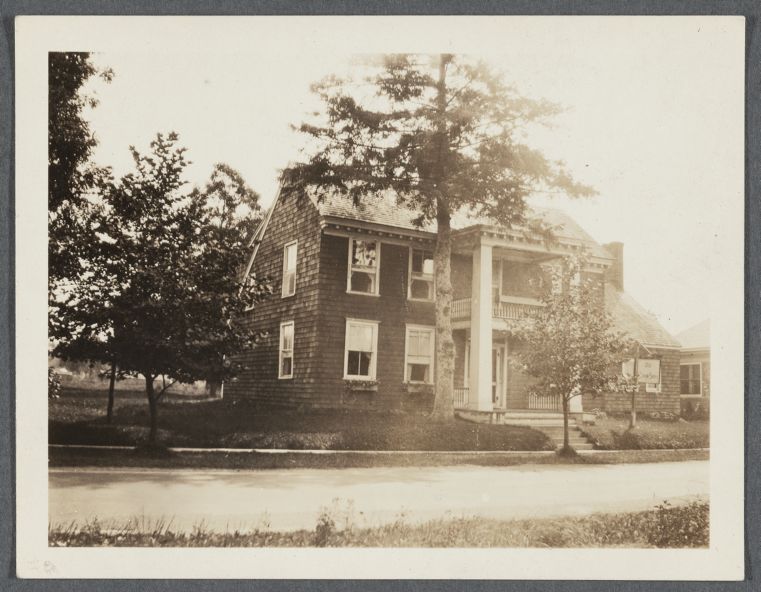
The house remained with the Jones family into the automobile era
The Three Village Historical Society has another useful photograph from 1910 showing Walter D. Jones, Bertha M. Jones and their daughter Ada in a Willys Overland automobile in front of their Main Street home. The society identifies the house in that photograph as Old Shinglesides.
Fourteen years later, Armbruster photographed the property under a different use. His September 1924 image identifies it as the Old Shingled Sides Tea Room.
Exactly who operated the tea room, when it opened and how long it remained in business are not established by the sources located for this article. I also found no reliable period menu or advertisement that would justify describing what was served there. The photograph itself, however, directly documents the tea-room use in 1924.
The timing was consistent with a national trend. The National Park Service notes that tea rooms became common during the early decades of automobile travel, particularly in the 1910s and 1920s. Rural and roadside tea rooms were frequently established in existing houses and historic structures, and many were operated by women. They provided meals and refreshments to a growing population traveling by automobile, although there is not enough evidence to say specifically who patronized the East Setauket establishment.
East Setauket was changing around it
Armbruster’s photograph also predates a significant change to the road itself. According to Tyler’s history of East Setauket’s Main Street, the road was first paved in 1926, two years after the tea-room photograph was taken. Until then, the village road system had retained much of its earlier rural character.
Old Shinglesides was still drawing attention that same year. A postcard reproduced by Tyler is identified as “Old Shinglesides by Howard Chandler Christy,” dated July 16, 1926.
The documented 20th-century sequence therefore includes:
- 1910: Members of the Jones family were photographed with an automobile in front of Old Shinglesides.
- 1924: Eugene L. Armbruster photographed the property as the “Old Shingled Sides” Tea Room.
- 1926: East Setauket’s Main Street was paved, and a postcard identified as a Howard Chandler Christy depiction of Old Shinglesides was dated that July.
Old Shinglesides was moved in 1962
The house remained at its original Main Street location until 1962. Tyler’s account says it was moved when the site was needed for construction of a post office. Ward Melville had the old house relocated and restored rather than demolished.
A separate account of Melville’s preservation work likewise lists Old Shinglesides among the historic Setauket buildings he purchased and moved to save. The house was relocated to Gnarled Hollow Road, where it became a private residence overlooking a small pond.
That gives the 1924 Armbruster photograph a broader context. It does not simply document a former East Setauket restaurant. It records one relatively brief use of a house whose history reaches back to the mid-18th century, remained closely associated with generations of the Jones family, and continued after the structure itself was moved from Main Street.
Old Shinglesides still survives, although not where Armbruster photographed it. The tea room disappeared, the original site was redeveloped, and the house was preserved elsewhere in East Setauket.
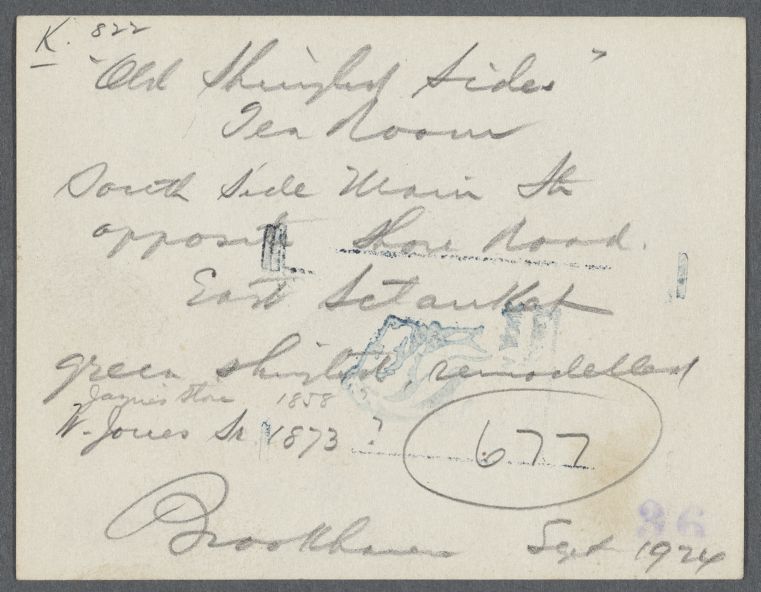
Photo: “Old Shingled Sides” Tea Room on the south side of Main Street opposite Shore Road in East Setauket, September 1924; the location and date are recorded on the reverse of the photograph. Photo by Eugene L. Armbruster, Irma and Paul Milstein Division, The New York Public Library Digital Collections.
Sources
- New York Public Library Digital Collections, “Old Shingled Sides” Tea Room, Eugene L. Armbruster
NYPL Digital Collections item - Beverly C. Tyler, “History Close at Hand: East Setauket’s early days,” TBR News Media
TBR News Media article - Thomas J. Vivian, “Straggling Setauket,” Frank Leslie’s Popular Monthly, August 1895, transcription with original-page images and scan references
Straggling Setauket, 1895 - Three Village Historical Society Archives, Walter D. Jones family photograph, 1910
Three Village Historical Society archives - Beverly C. Tyler, “The development of Main Street through the decades,” TBR News Media
East Setauket Main Street history - National Park Service, “Roads, Model T’s, Tourists, and Tea Rooms”
National Park Service tea-room history - Ward Melville preservation accomplishments, including Old Shinglesides
Ward Melville preservation document