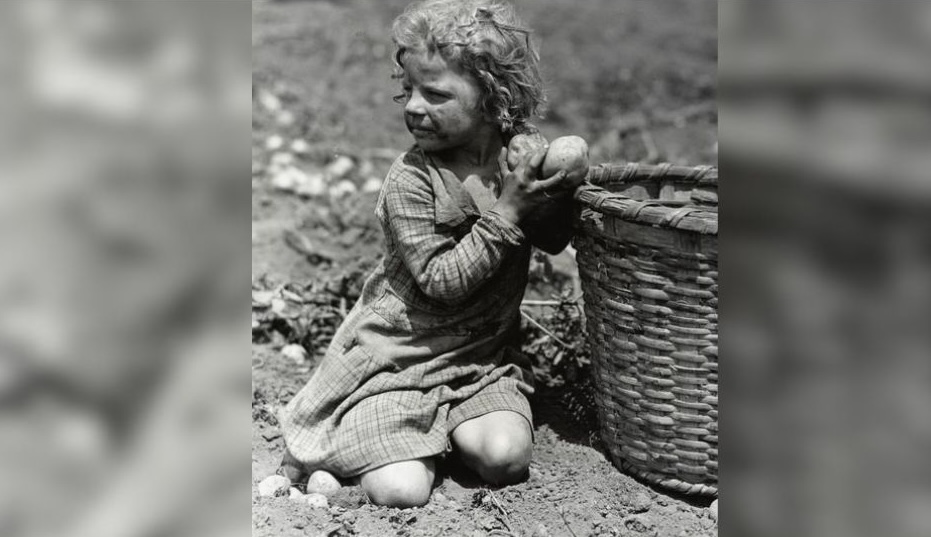
It’s easy to forget how recently Long Island was still deeply agricultural. Before subdivisions and shopping centers, large parts of Nassau County were working farmland, and families depended on every available set of hands.
This photograph, taken in 1931, captures that reality in a direct way. It shows a four-year-old child helping her family pick up potatoes in Hicksville, part of a broader effort to document labor conditions across the United States.
A Documented Moment, Not a Staged Scene
The image comes from a larger body of work focused on social conditions in the early 20th century:
- The photograph is attributed to Lewis Wickes Hine, a photographer known for documenting labor practices
- It was produced as part of a series examining child labor in the United States between 1905 and the early 1930s
- The work was supported by the National Child Labor Committee, which used images like this to raise awareness
This was part of a coordinated effort to record how and where children were working. The subject of the image is identified simply:
- A four-year-old child assisting in picking up potatoes
- Working alongside family members in a harvested field
- Engaged in manual labor typically associated with seasonal farm work
There’s no indication of posed conditions. The image reads as a straightforward record of a working day. Photographs like this were part of a broader national conversation.
- Child labor was still common in many industries in the early 20th century
- Advocacy groups used visual documentation to push for labor reforms
- Images from photographers like Hine were circulated to influence public opinion and policy
By the early 1930s, these efforts were contributing to increased regulation of child labor practices across the country.
Photo: A four-year-old child helping her family pick up potatoes, Hicksville, Long Island, 1931. Photograph by Lewis Wickes Hine. Courtesy of the New York Public Library, Photography Collection.