What looked like a routine payment request turned into a multi-million-dollar nightmare for a Long Island school district and investigators say the suspect didn’t waste a second once the money hit her account.
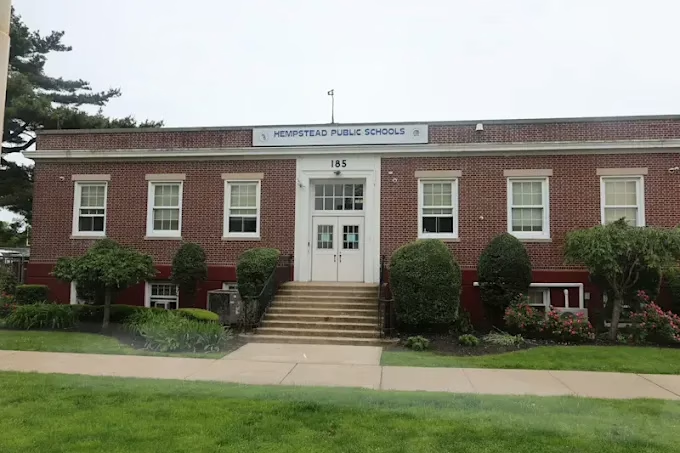
Prosecutors say the scheme began quietly in January 2024, when the Hempstead Union Free School District received what appeared to be a legitimate email from a local charter school. The message requested that future payments be sent to a new bank account.
Nothing about it raised alarms at first.
Two days later, the district transferred roughly $3.5 million to an account under the name “DME Unlimited,” believing it belonged to the school.
It didn’t.
Investigators later determined the account was controlled by 66-year-old Donna Eckert, a resident of Escondido, more than 2,700 miles away from Hempstead.
Then came the part that would ultimately unravel everything.
Within days of the transfer, surveillance cameras inside multiple California banks began capturing a pattern. On February 2, Eckert was allegedly seen withdrawing $25,000 in cash before depositing the same amount into her personal account at another branch. Days later, cameras again captured her allegedly pulling out a staggering $313,000 and moving it into her own account.
In total, investigators say she withdrew and transferred $338,000 for personal use from the stolen funds in just a matter of days.
Those transactions, paired with bank records and surveillance footage, became the turning point in the case.
The alleged scheme itself traces back to a compromised email account. Authorities say a finance director’s email tied to a local charter school had been hacked, allowing someone to send a convincing, but fraudulent, payment request to the district.
By the time the fraud was discovered on February 14, the money had already been moved.
More than two years later, the investigation led authorities across the country. Eckert was arrested on March 10, 2026, by local police in California and extradited back to New York on April 1 by Nassau County detectives.
She was arraigned in Mineola and pleaded not guilty. Prosecutors say she faces up to 25 years in prison if convicted.
Officials say the case is a stark reminder of how a single compromised email can trigger massive financial losses, especially when requests involve changes to payment accounts.
Authorities stress that verifying payment changes through direct contact remains one of the simplest ways to stop these scams before millions disappear.
The charges are accusations, and the defendant is presumed innocent unless and until proven guilty.
Find Crime News in Your Town
Explore arrests, investigations and crime reports from communities across Long Island.