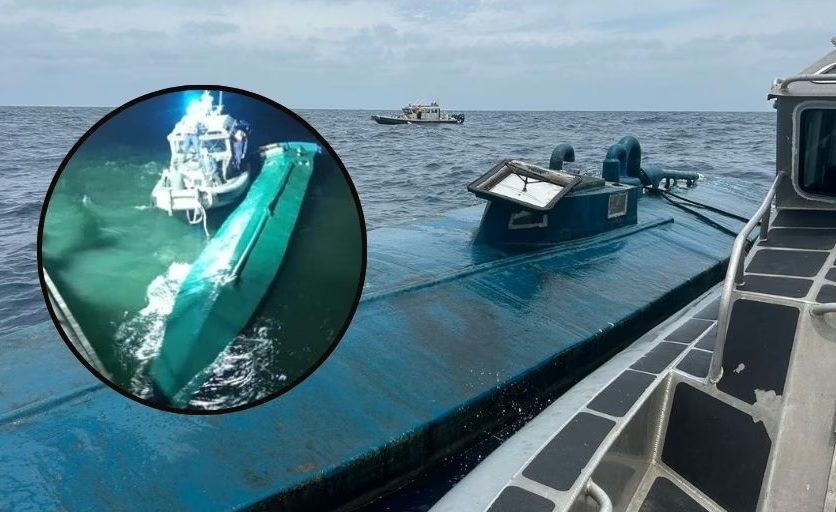
For years, they operated in near silence beneath the surface of the ocean.
Hidden inside homemade submarine-like vessels, prosecutors say this group moved massive shipments of cocaine across international waters, believing they were invisible.
But this week, that operation surfaced in a very public way, inside a federal courtroom in Brooklyn.
Seven men accused of being part of a sophisticated international drug trafficking network were extradited from Colombia and arraigned in federal court in Brooklyn on March 27, according to the U.S. Attorney’s Office for the Eastern District of New York.
Authorities say the group used semi-submersible vessels, low-profile crafts designed to avoid radar and detection, to transport tons of cocaine from the Pacific coast of Colombia toward Mexico, where the drugs would ultimately be routed into the United States.
The operation, according to prosecutors, was anything but simple.
Investigators say the group functioned like a business. Investors funded multi-ton cocaine shipments. Engineers and workers built the vessels. Crews were hired to transport the drugs across open ocean. Even fishing boats were strategically placed along routes to act as lookouts, scanning for law enforcement before the vessels moved through.
The turning point came at sea.
In June 2023, the Colombian Navy intercepted one of these vessels near the country’s Pacific coast, seizing more than 2,300 kilograms of cocaine. Months later, in October 2023, another semi-submersible was stopped, this time carrying roughly 3,300 kilograms.
Those seizures cracked open the operation.
According to prosecutors, evidence recovered from the vessels, including navigation data and communications, helped investigators map out the broader network, identifying key players involved in financing, construction, coordination, and transport.
That investigation eventually stretched across continents.
Working with international partners, including Colombian authorities, the DEA, and Homeland Security Investigations, U.S. officials built the case that led to arrests in Colombia in March 2025.
Now, a year later, the suspects have been brought to New York.
Prosecutors allege the group conspired to traffic more than five tons of cocaine using these vessels, with some members overseeing entire launches, while others handled logistics, construction, or countersurveillance at sea.
Officials say the case highlights how far drug trafficking organizations will go to evade detection and how far investigators will go to stop them.
The charges are allegations, and the defendants are presumed innocent unless and until proven guilty in court.
Photo credit: U.S. Attorney’s Office, Eastern District of New York