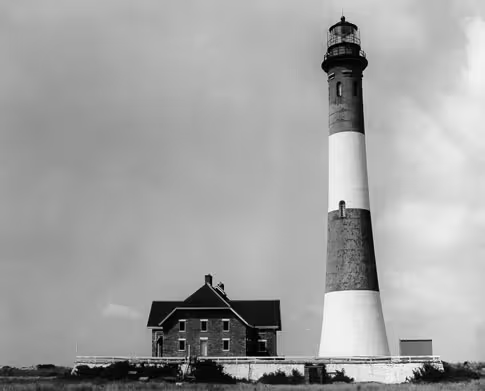
The Fire Island Lighthouse is the tallest lighthouse on Long Island, but its 168-foot height is only part of its story.
The familiar black-and-white tower standing between the Atlantic Ocean and Great South Bay is actually Fire Island’s second lighthouse. Its predecessor was considered too short, the current tower was nearly abandoned after more than a century of service, its original light once burned whale oil, and the changing shoreline has left the lighthouse miles from the western end of Fire Island that it once marked.
Visitors who climb the tower also have 182 steps between the ground and the gallery near the top.
Here’s the history behind one of Fire Island’s most recognizable landmarks.
How tall is the Fire Island Lighthouse?
At 168 feet, the Fire Island Lighthouse is the tallest lighthouse on Long Island.
That makes it more than 50 feet taller than the tower at Montauk Point Lighthouse. The added height was not simply an architectural choice. It addressed a serious problem with the lighthouse that came before it.
The light from the current tower has a focal plane of about 166 to 168 feet above sea level and historically could be seen by ships more than 20 nautical miles offshore.
On clear days, visitors looking west from the tower can also see the New York City skyline.
How many steps are in the Fire Island Lighthouse?
There are 182 steps to the top.
Visitors who make the climb reach the gallery platform, where they get 360-degree views of Fire Island, Great South Bay, the Atlantic Ocean and, when visibility allows, Manhattan in the distance.
The tower remains open for public tours, making Fire Island Lighthouse one of Long Island’s historic lighthouses that visitors can still climb.
The Fire Island Lighthouse you see today is actually the second one
Fire Island’s first lighthouse went into service in 1826 near the western end of the barrier island.
It looked very different from the tower standing there today.
The original lighthouse was:
- 74 feet tall
- Octagonal in shape
- Constructed from Connecticut River blue split stone
- Equipped with oil lamps
- Visible roughly 10 to 14 nautical miles offshore
For ships approaching New York Harbor, the light was not considered adequate.
In 1852, the federal Lighthouse Board recommended increasing both the height and intensity of the Fire Island light. Congress eventually appropriated $40,000 for a replacement tower.
The current Fire Island Lighthouse was completed in 1858 and first illuminated on November 1 of that year.
What happened to the first Fire Island Lighthouse?
When the original lighthouse was demolished, some of its materials were reused during construction of the new light station and surrounding terrace.
The foundation of the first lighthouse also survives and can still be seen near the present tower.
Visitors can therefore see the remains of the structure that guided ships along this part of Long Island before the familiar striped lighthouse was built.
The Fire Island Lighthouse was not originally black and white
The black-and-white bands are now one of the lighthouse’s defining features, but the tower did not look that way when it opened.
The new lighthouse was originally a cream or yellowish color.
Its alternating black-and-white bands, known as a daymark, were added around 1891-92. The pattern made the lighthouse easier for sailors to identify during daylight hours and distinguished it from other lighthouses along the coast.
The design has since become one of the most recognizable lighthouse profiles on Long Island.
How did the original Fire Island Lighthouse light work?
When the current lighthouse began operating in 1858, it contained a large first-order Fresnel lens manufactured in France by the Henry-Lepaute company.
The beehive-shaped assembly stood about 16 feet high and was made from a complex arrangement of glass prisms and brass.
A Fresnel lens does not produce light. Instead, its arrangement of glass prisms gathers and concentrates light, allowing it to be seen from much farther away.
The original Fire Island Lighthouse lamp burned oils that included whale oil, while a clockwork mechanism rotated the lens. The lighthouse initially produced a five-second flash approximately once every minute.
The original Fresnel lens remained in the tower until the 1930s.
The original Fresnel lens left Long Island for decades
In 1933, the original first-order Fresnel lens was removed from service.
It eventually went on display at Philadelphia’s Franklin Institute, where it remained for decades.
The lens was later returned to Fire Island, and a special building was constructed near the lighthouse to display it. The restored lens went on public view there in 2011.
Visitors can now see the original lens that once projected the Fire Island light miles across the Atlantic.
A hurricane interrupted the lighthouse’s move to electricity
The Fire Island Lighthouse began converting from oil-based lighting to electricity during the 1930s.
Electricity reached the lighthouse on September 20, 1938.
The following day, the Hurricane of 1938 struck Long Island and severed electrical service to the island, delaying completion of the lighthouse’s electrification.
The station was ultimately restored with electric lighting in 1939.
What does the Fire Island Lighthouse light look like today?
The technology inside the tower has changed repeatedly since the days of whale oil and clockwork machinery.
For years, the modern beacon used two 1,000-watt bulbs with an optical system rotating counterclockwise and producing the lighthouse’s characteristic flash approximately every 7.5 seconds.
The beacon is visible for more than 20 miles at sea.
Although the equipment has changed, the lighthouse continues to serve the same basic purpose of identifying Fire Island and helping mariners navigate the waters off Long Island.
Why was the Fire Island Lighthouse decommissioned?
After more than a century of service, the lighthouse was showing significant deterioration.
On December 31, 1973, the Coast Guard decommissioned Fire Island Lighthouse as an aid to navigation.
It was replaced by a small flashing optic installed atop the water tower at Robert Moses State Park.
The historic lighthouse then remained dark for more than a decade, and its deteriorating condition raised questions about whether the structure would survive.
Long Islanders helped save the Fire Island Lighthouse
The replacement light served vessels offshore, but it was less useful to some boaters navigating Great South Bay because the strobe on the Robert Moses tower was primarily directed toward the ocean.
Local support grew for restoring the historic lighthouse.
The Fire Island Lighthouse Preservation Society was formally established in 1982 as concerns mounted over the future of the tower. The organization eventually raised more than $1 million toward its restoration.
On Memorial Day, May 25, 1986, the Fire Island Lighthouse was relit and returned to service as an active aid to navigation.
Today, the Fire Island Lighthouse Preservation Society helps operate and maintain the historic light station in cooperation with the National Park Service.
The lighthouse is now miles from Fire Island’s western end
One of the more unusual facts about the Fire Island Lighthouse involves the changing geography around it.
When the original lighthouse was established, it stood near the western end of Fire Island and Fire Island Inlet.
Over time, sand carried along the coastline accumulated west of the lighthouse, gradually extending the barrier island farther toward the west.
As a result, the lighthouse that once stood near Fire Island’s western tip is now roughly five miles east of the present end of the island near Democrat Point.
The change illustrates how significantly Long Island’s barrier beaches can shift over long periods of time.
Was Fire Island Lighthouse on “Guiding Light”?
From 1970 to 1975, Fire Island Lighthouse and the surrounding area appeared in the opening and closing credits of the CBS soap opera “Guiding Light.”
The lighthouse has also appeared in or around productions including “Men in Black II,” “What Happens in Vegas” and the television series “The Following.”
Its distinctive appearance has made it a recognizable filming location as well as a navigational landmark.
Is the Fire Island Lighthouse haunted?
Like many old Long Island landmarks, Fire Island Lighthouse has accumulated a number of ghost stories.
One local legend tells of a lighthouse keeper who supposedly lost a child while stationed at Fire Island and later died by suicide inside the tower. Versions of the story claim that a shadowy figure or other unexplained activity has since been encountered at the lighthouse.
The story is part of local folklore rather than established historical fact.
The documented history of the lighthouse includes shipwrecks, storms, generations of lighthouse keepers, changing technology and more than 160 years of service at the current tower.
Can you visit and climb the Fire Island Lighthouse?
Yes.
Fire Island Lighthouse is located within Fire Island National Seashore just east of Robert Moses State Park.
From the mainland, one of the easiest approaches is to drive to Robert Moses State Park Field 5 and follow the boardwalk roughly three-quarters of a mile to the lighthouse.
Visitors can explore exhibits on Fire Island’s maritime history, see the original first-order Fresnel lens and, when tower tours are operating, climb the 182 steps to the top.
The lighthouse is also accessible from Fire Island communities by walking, biking or water taxi.
More than the tallest lighthouse on Long Island
The height of Fire Island Lighthouse gives it an easy claim to fame, but its history extends well beyond that distinction.
There have been two Fire Island lighthouses. Materials from the first were reused in the second. The current tower changed colors, transitioned from oil to electricity, survived the Hurricane of 1938 during that conversion, went dark for more than a decade and was ultimately restored through a local preservation effort.
At the same time, the shoreline around the lighthouse continued to change, leaving a tower originally built near the western end of Fire Island several miles east of that point today.
More than 165 years after the current lighthouse was first illuminated, it remains an active aid to navigation and one of the most recognizable historic structures on Long Island.