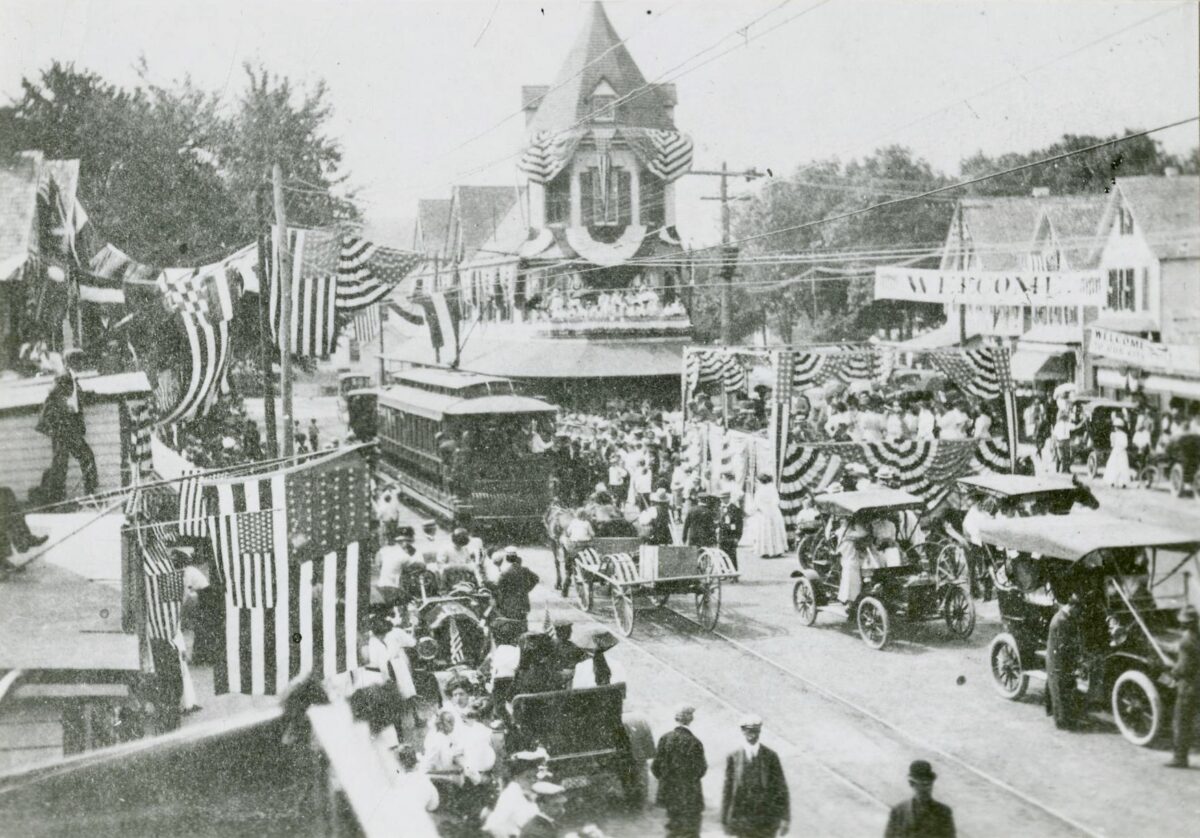
Long Island once had an electric trolley that carried passengers from Huntington Harbor to the Great South Bay, connecting the North and South Shores along a route that roughly followed today’s Route 110. When the 18.5-mile Cross-Island Line officially opened on August 25, 1909, passengers could make the entire trip from Halesite to Amityville in approximately 76 minutes for a fare of 30 cents.
The trolley operated during a period when electric street railways were becoming an important part of Long Island’s transportation system. Before automobiles became widespread, these lines provided convenient connections between railroad stations, village centers, workplaces and waterfront destinations. The Cross-Island Line was an ambitious addition to that network, although the complete route remained in service for only about a decade.
From a Horse-Drawn Trolley to an Electric Railway
The history of the Cross-Island Line began nearly 20 years before its opening. In 1890, the Huntington Railroad Company established a three-mile horse-drawn trolley route connecting Huntington Village with Halesite on Huntington Harbor. The service provided transportation between the village and the waterfront, where commercial activity and recreational boating generated passenger traffic.
The Long Island Rail Road subsequently acquired the Huntington Railroad and electrified its tracks in 1898. Electric operation allowed the company to provide more modern and efficient service, and plans eventually developed to extend the line southward across the Island.
By 1909, construction had been completed on an 18.5-mile route reaching Amityville. The new line traveled through Huntington, West Hills, Melville and Farmingdale before continuing to the Great South Bay. Much of the route followed the approximate alignment of present-day Route 110, making its path relatively easy to visualize for anyone familiar with the busy north-to-south roadway.
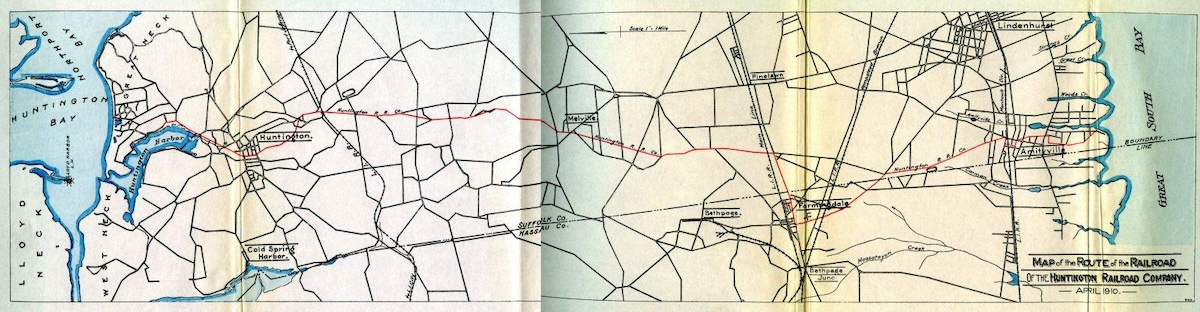
Photo: An April 1910 map of the Huntington Railroad Company showing the Cross-Island Trolley route from Huntington Harbor through Melville and Farmingdale to Amityville on the Great South Bay. Credit: Huntington Railroad Company
The Route Across Long Island
The Cross-Island Line was divided into six fare zones, each approximately three miles long. Passengers paid five cents per zone, with the complete trip costing 30 cents. The fare structure made the trolley practical for shorter local journeys as well as the full crossing between the two shores.
The six fare zones were identified by these locations:
- Halesite: The northern terminal on Huntington Harbor.
- Huntington Station: A connection with the Long Island Rail Road.
- DeForest Farm: A stop in West Hills.
- Duryea Farm: A stop in Melville.
- Farmingdale Station: Another connection with the LIRR.
- Amityville: The southern terminal near the Great South Bay.
The references to DeForest Farm and Duryea Farm are particularly interesting today. Both reflect the rural character of central Long Island at the beginning of the 20th century, when much of the territory between the established North Shore and South Shore communities consisted of farmland and comparatively undeveloped property.
Click here for more stories about the LIRR and Long Island railroads.
The trolley also required infrastructure that has largely disappeared from the local landscape. Tracks passed beneath the LIRR at Huntington and Farmingdale and crossed above the railroad at Amityville. Car barns were located at Halesite and Amityville, while electrical substations operated at the Huntington and Farmingdale railroad stations.
Opening Day in Amityville
The Cross-Island Line officially opened on August 25, 1909, with celebrations in Amityville that included an automobile parade, fireworks and other entertainment. The occasion reflected the importance attached to improved transportation during a period of considerable growth and development on Long Island.
The new service operated on an hourly schedule, with a complete one-way trip taking approximately 76 minutes. Its equipment included six large double-truck, semi-convertible trolley cars and seven smaller single-truck cars, the latter providing more frequent service to local railroad stations.
The line also offered useful connections with the LIRR. At Farmingdale, a spur from Conklin Street allowed trolley passengers to reach the railroad station and transfer to trains serving Brooklyn and New York City. These connections made the trolley part of a larger regional transportation system rather than simply a route between two waterfront communities.
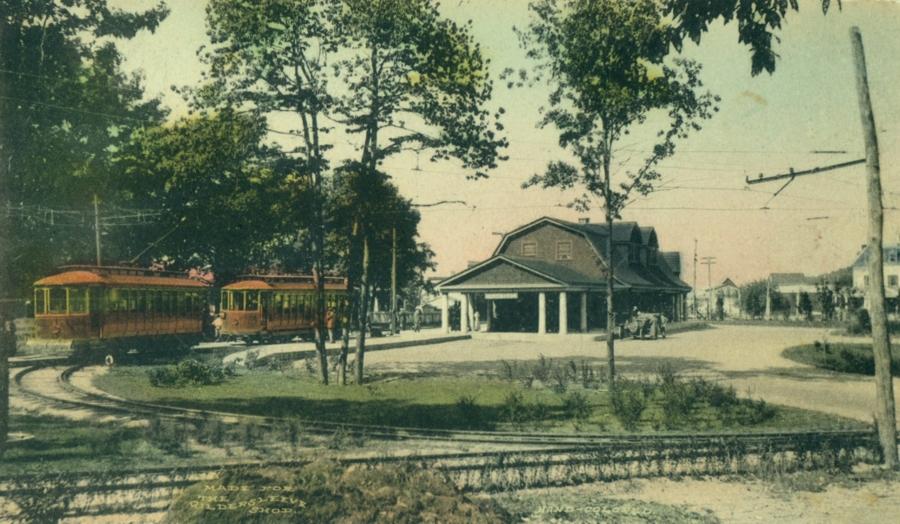
Photo: Two Huntington Railroad electric trolley cars near Huntington Station, circa 1910, part of the railway system that connected Huntington Harbor with Amityville. Credit: Historical colorized postcard.
Commuters, Beachgoers and Connecting Trolleys
The Cross-Island Line served a variety of passengers, including workers traveling to industrial businesses and residents making local trips. One destination was the Fulton Truck Assembly Plant in East Farmingdale, where the trolley provided transportation for employees.
Recreational travel was another important part of the business. Passengers could use the line to reach the Long Island Sound waterfront at Halesite or the Great South Bay at Amityville, making the trolley particularly useful during the warmer months.
The transportation network expanded further in 1910 when the Babylon Railroad began operating an electric trolley between Amityville and Babylon Village, passing through Copiague, Lindenhurst and West Babylon. Travelers arriving in Amityville on the Cross-Island Line could transfer to the South Shore trolley and continue eastward.
These intersecting routes made it possible to travel between several Long Island communities without relying on a horse-drawn carriage or automobile. For residents of the period, the trolley systems represented an improvement in local mobility, particularly where conventional railroad service did not provide a direct connection.
The line also developed its own local personalities. According to the Town of Babylon’s Office of Historic Services, a motorman named Benny Cirincione was remembered for singing Italian opera arias while collecting passenger fares. It is one of the smaller details preserved in historical accounts of the trolley’s operation.
Why the Cross-Island Line Disappeared
Despite the enthusiasm surrounding its opening, the complete Cross-Island Line operated for only about ten years. On September 23, 1919, service to Amityville ended, eliminating the direct trolley connection between Huntington Harbor and the Great South Bay.
The Huntington Railroad faced the same financial pressures affecting electric street railways elsewhere in the country. Increasing automobile ownership presented new competition, while rising operating costs associated with World War I placed additional strain on the business.
The original trolley service between Huntington Village and Halesite survived the closing of the Cross-Island route. That portion was sold to the Huntington Traction Company and continued operating until 1927, when it too was discontinued.
The South Shore’s Babylon Railroad followed a similar trajectory. Its electric service between Amityville and Babylon ended on May 25, 1920, less than a year after the Cross-Island connection to Amityville was discontinued.
A Different Era of Long Island Transportation
The Cross-Island Line is a reminder of how extensively Long Island’s transportation network has changed. Communities such as Melville and Farmingdale were far less developed in 1909, and electric trolleys offered an alternative to traveling by horse, automobile or railroad.
Today, Route 110 is one of the Island’s busiest commercial corridors, carrying thousands of automobiles, trucks and buses through much of the territory once served by the trolley. The original tracks, car barns and other facilities have disappeared, but photographs and historical records preserve the story of the unusual north-to-south railway.
For ten years, Long Islanders could board an electric trolley near Huntington Harbor and ride directly to Amityville on the Great South Bay. The service lasted only a relatively short time, but it was an important part of the Island’s early transportation history and an interesting predecessor to the road network that eventually replaced it.
Header photo (Opening-day celebration): Crowds gather along Broadway in Amityville on August 25, 1909, to celebrate the opening of the Cross-Island Trolley connecting Huntington Harbor with the Great South Bay. Credit: Photograph by William J. Rugen, Queens Public Library collection.
Sources: Long Island’s Cross-Island Trolley (1909–1919)
- Town of Babylon Office of Historic Services, “Tracking the History of Babylon Town’s Trolley Line” https://www.babylonbeacon.com/articles/tracking-the-history-of-babylon-towns-trolley-line/
- Farmingdale Public Library, Farmingdale History Encyclopedia, “The Cross-Island Trolley” https://farmingdalelibrary.libguides.com/c.php?g=755114&p=5411917
- Town of Huntington, “Summer Resort Era” https://www.huntingtonny.gov/content/13747/99540/16487/16495/default.aspx
- TrainsAreFun, “LIRR Extra List,” Huntington Railroad History, Maps and Photographs https://www.trainsarefun.com/lirr/lirrextralist/lirrextralist.htm
- TrainsAreFun, “LIRR Amityville,” Historic Cross-Island Trolley Photographs https://www.trainsarefun.com/lirr/Amityville/amityville.htm
- Historical Marker Database, “Amityville Trolley Routes” https://www.hmdb.org/m.asp?m=125959
- Queens Public Library photograph, “Trolley Day Celebration in Amityville,” August 25, 1909 https://www.hmdb.org/PhotoFullSize.asp?PhotoID=453130
- Additional historical reference: Vincent F. Seyfried, The Cross-Island Line: The Story of the Huntington Railroad (1976), identified in Farmingdale Public Library’s historical bibliography.