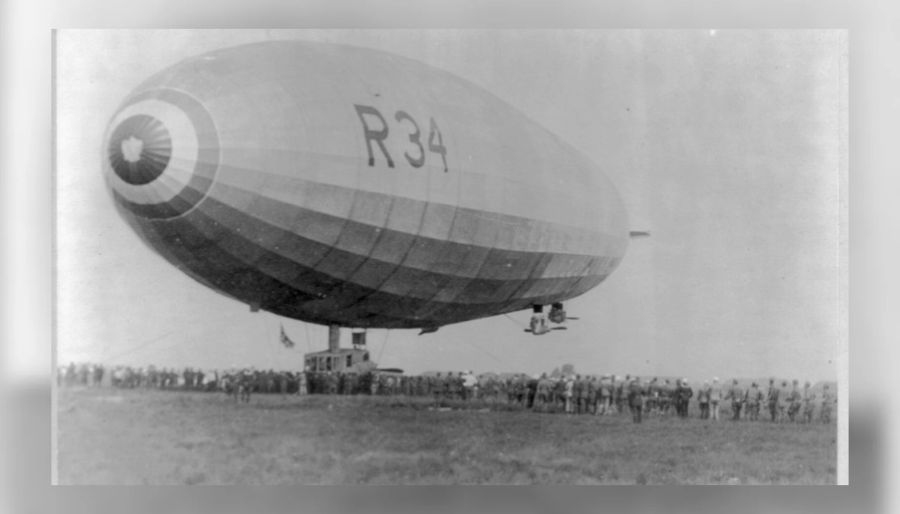
Long Island history is closely associated with Charles Lindbergh’s 1927 flight from Roosevelt Field to Paris, but the airfield at Mineola had already played a major role in transatlantic aviation eight years earlier. In July 1919, the British rigid airship R34 crossed the Atlantic from Scotland, landed at Roosevelt Field and then returned to England, becoming the first aircraft of any kind to cross the Atlantic in both directions.
The achievement came at a time when long-distance aviation was still highly experimental. R34 departed East Fortune, Scotland, at 1:42 a.m. on July 2, 1919, bound for Long Island. The rigid airship was more than 640 feet long and represented a very different approach to transatlantic travel from the airplanes that would later dominate international aviation.
The first east-to-west aerial crossing of the Atlantic
The westbound journey was difficult and considerably slower than the return trip. R34 encountered unfavorable weather and persistent headwinds, while fuel became an increasing concern as the flight continued into its fourth day.
Among the challenges recorded during the crossing:
• Strong headwinds slowed the airship’s progress across the Atlantic.
• Fuel reserves became a concern as the flight stretched beyond four days.
• National Museums Scotland records that the crew used chewing gum as part of an improvised repair to deal with a leak during the journey.
R34 finally reached Roosevelt Field in Mineola at 9:54 a.m. on July 6, 1919, after 108 hours and 12 minutes in the air. The arrival marked the first successful aerial crossing of the Atlantic from east to west, an important distinction in an era when aircraft range, navigation and reliability remained major limitations.
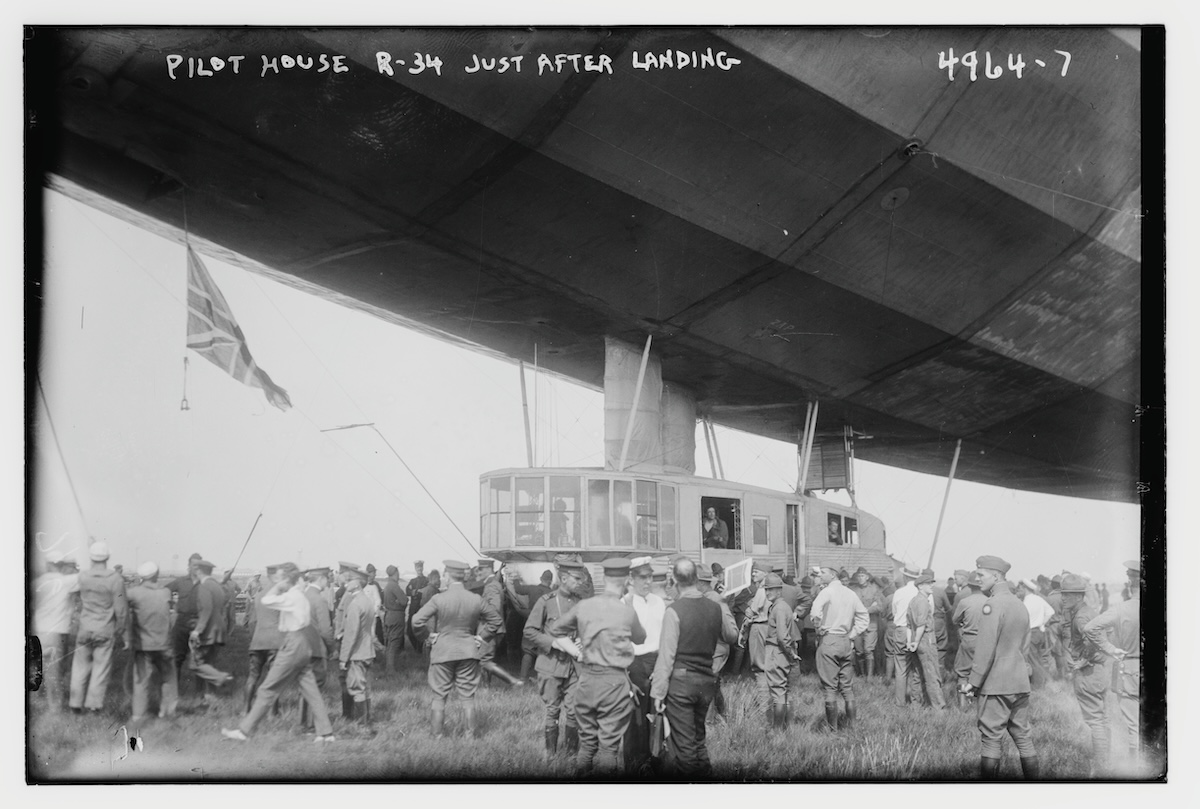
Photo: The pilot house of the British airship R-34 just after landing at Mineola, Long Island, on July 6, 1919, following its transatlantic flight from Scotland. Bain News Service photograph, George Grantham Bain Collection, Library of Congress. No known restrictions on publication.
Mineola became the midpoint of a larger aviation record
The flight had been planned as more than a one-way demonstration. British organizers intended to show that an airship could make the Atlantic crossing in both directions, potentially establishing the practicality of regular long-distance air travel between Europe and North America.
R34 remained on Long Island for three days before departing Roosevelt Field shortly before midnight on July 9. Before turning east toward the Atlantic, the airship flew over New York City, including Times Square, providing New Yorkers with a rare view of one of the largest aircraft of the period.
The eastbound journey proved much faster than the crossing to Long Island:
• R34 reached Pulham, England, after 75 hours and 3 minutes.
• The completed round trip made R34 the first aircraft of any kind to cross the Atlantic in both directions.
• The achievement occurred eight years before Lindbergh’s 1927 nonstop solo flight from Roosevelt Field to Paris.
R34 was not the first aircraft to cross the Atlantic. Just weeks earlier, John Alcock and Arthur Whitten Brown had completed the first nonstop transatlantic airplane flight from Newfoundland to Ireland. R34’s distinction was different: it was the first aircraft to make the crossing both ways, with Roosevelt Field serving as the American endpoint and turnaround point.
The flight included an unauthorized passenger
The historic mission also carried an unusual addition to its official crew. William Ballantyne, a member of R34’s crew who had been removed from the roster for the transatlantic flight, secretly hid aboard before departure from Scotland.
Ballantyne was discovered only after the airship was already well into the journey. National Museums Scotland describes him as the first human transatlantic aerial stowaway, an unusual footnote to an otherwise carefully planned military and aviation operation.
He was not the only unexpected traveler aboard R34.
Wopsie the cat also crossed the Atlantic
The crew’s cat, Wopsie, was also aboard for the crossing. National Museums Scotland identifies Wopsie as the first feline transatlantic aerial stowaway, giving the flight an additional distinction beyond its formal aviation records.
The mission also carried two pigeons, reflecting an era when long-distance aviation combined advanced engineering with communication methods that still belonged partly to an earlier age.
The arrival was documented in Mineola
R34’s arrival at Roosevelt Field attracted considerable attention and was photographed extensively. Images preserved by the Library of Congress show the airship at Mineola immediately after completing its four-and-a-half-day journey from Scotland.
Other photographs document preparations for the arrival, including a searchlight positioned at Mineola to assist with locating and guiding the airship. The surviving images provide a clear sense of the scale of R34 and the significance attached to its arrival on Long Island.
The photographs also place the event firmly within the broader development of the Mineola and Garden City aviation fields, which were becoming internationally important centers for experimental flight during the early 20th century.
Long Island was already part of transatlantic aviation history before Lindbergh
Lindbergh’s 1927 departure from Roosevelt Field remains the best-known episode in Long Island aviation history, but it was not the beginning of the region’s role in transatlantic flight. R34’s arrival in 1919 demonstrated that Long Island was already serving as a destination for major international aviation experiments.
For more than four days, the British airship crossed the Atlantic from Scotland to Mineola. Three days later, it left Roosevelt Field and successfully completed the return trip to England. By the end of the mission, R34 had become the first aircraft to cross the Atlantic in both directions, with Long Island at the center of the achievement.
The flight also left behind one of the more unusual stories of early aviation: a record-setting British airship, an unauthorized crewman and a cat named Wopsie, all arriving together at Roosevelt Field in the summer of 1919.
Cover Photo: Landing of the British dirigible R-34 at Mineola, Long Island, on July 6, 1919. Bain News Service photograph, George Grantham Bain Collection, Library of Congress. No known restrictions on publication.
Sources:
- Cradle of Aviation Museum — R-34 Dirigible
https://www.cradleofaviation.org/history/history/historical_events/r-34_dirigible.html - National Museums Scotland — Stowaways and cats: the first transatlantic flight from Britain to the United States
https://www.nms.ac.uk/discover-catalogue/stowaways-and-cats-the-first-transatlantic-flight-from-britain-to-the-united-states - Library of Congress — R34 Landing at Mineola, July 6, 1919
https://www.loc.gov/item/98502785/ - Library of Congress — R34 and preparations surrounding its Mineola arrival
https://www.loc.gov/pictures/search/?q=R34%20Mineola